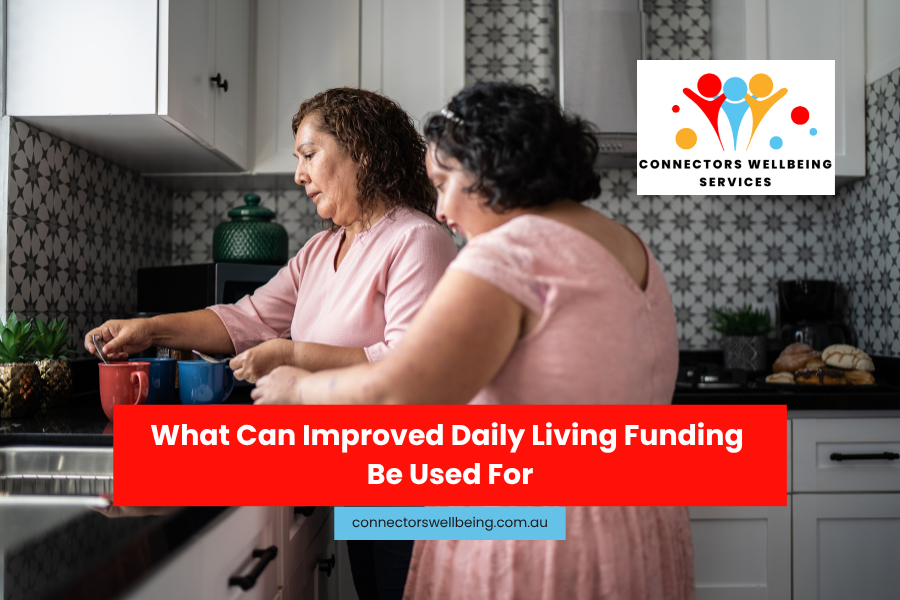
If you’ve seen this category in your NDIS plan and wondered, “What can Improved Daily Living funding be used for, exactly?” You’ve come to the right place.
Here at Connectors Wellbeing, we’re all about giving NDIS participants in Darwin and across Australia the choice and control to live their best life. This category, formally known as CB Daily Activity (Capacity Building – Daily Activity), is one of the most powerful tools in your plan. It’s not just about getting support; it’s about building your ability to manage life day-to-day tasks on your own terms.
Unpacking the NDIS Capacity Building: Improved Daily Living
The Allied Health Dream Team: Supports for Improved Daily Living Skills NDIS
- Self-Care Skills: Strategies plus assisting devices for undressing, showering, grooming, and managing daily hygiene.
- Household Tasks: Teaching efficient and safe ways to cook, clean, and manage laundry.
- Assistive Technology (AT) Assessments: Recommending and assessing low-cost AT (like specialised cutlery or shower chairs) to boost independence.
- Physiotherapy: Enhancing gross motor skills, increasing muscle strength, improving balance, and managing pain.
- Exercise Physiology: Customizing safe, structured exercise programs that are designed specifically for one to have strength, stamina, and physical function depending on the type of disability.
- Improve verbal and non-verbal communication skills (including using AAC devices).
- Develop safe swallowing and feeding strategies (dysphagia management).
- Uplifting social communication and interaction skills.
Your mental and emotional wellbeing is a core part of your daily living skills. This funding covers:
- Counselling and therapeutic support to manage stress, anxiety, or low mood.
- Behavior support and strategy development to facilitate better access to social or difficult environments.
Beyond Therapy: Practical Skill-Building and Training
NDIS capacity building improved daily living isn’t just about sitting on a couch talking to a therapist; it’s about practical, hands-on training to embed new abilities into your routine. This is where you work with professionals to turn strategies into daily habits.
| Practical Skill Area | What the Funding Covers | Why It’s Important |
|---|---|---|
| Home & Routine Management | Moreover, people can acquire skills in meal prep, budgeting, calendar management, and home organization. | It helps to build self-management, control, and lessens dependence on support staff. |
| Travel & Community Access | Training to use public transport independently, plan routes, and navigate community settings safely. | Raises the level of your social and communal engagements, thereby giving you the power to move around and participate in society. |
| Social and Life Skills | The educational process is concentrated on allowing a person to train to create and maintain healthy relationships, to resolve conflicts, and to perceive and follow social cues and interaction patterns. | A prerequisite for one’s living standard, it helps to befriend and integrate into the local Darwin community. |
| Training for Support Networks | Training your family, carers, or support workers to ensure they implement your therapy plan consistently and effectively. | Provides a harmonious, expert commitment to your assistance, thus ensuring the highest level of your independence. |
Making the Most of Your Improved Daily Living Funding
Flexibility is a Ripper Bonus
One of the best things about the Capacity Building budget is that it’s generally flexible within the category. This means you can often shift funds between the various supports (like between an OT and a Speech Pathologist) as your needs change—just double-check your NDIS plan to confirm if your funding is ‘stated’ or ‘flexible’.
You may also like our blog: What Is NDIS Assistance with Daily Living? A Complete Guide
In the selection of a provider in Darwin, the best option would be the one that provides mobile or in-home therapy. That would allow the therapist to meet you in your actual living spaces, be it the kitchen, bathroom, or local park, so that skill-training can be done in a more practical and relevant manner. We pride ourselves in providing professional, on-site support delivere d according to the Northern Territory lifestyle.
Conclusion
Improved Daily Living funding is not only a line item in a budget, but also a ticket to greater independence, confidence and a more fulfilling life. By understanding what can Improved Daily Living funding be used for, you empower yourself to access the therapists and training that will build your capacity, one skill at a time.
Connectors Wellbeing is the supplier of choice when it comes to specialized disability services in Darwin, ensuring that your funds are sold into reaping real, measurable results.

One Response